
The Research You Do Today Shapes the Decisions You Make Tomorrow

Before you plan 2027, understand what you still do not know, and why the gap between evidence and assumption is where most strategic risk lives.

Here is a pattern that repeats with striking regularity across healthcare organisations as they head into Q4. The commercial team opens the planning conversation with performance data from the current year. The brand team brings positioning frameworks. Medical affairs weighs in on the evidence landscape. Market access brings access conditions. Regional teams provide local context. And at some point, a set of assumptions about HCP behaviour, patient experience, market dynamics and competitive positioning quietly gets embedded into the plan for the following year.
Nobody marks those assumptions as assumptions. They arrive dressed as knowledge.
"We know what physicians in this segment prioritise." "We know how the market perceives our positioning." "We know which messages are working." "We know where the untapped opportunity sits."
Sometimes those statements are backed by strong, recent evidence. Sometimes they are based on a study from two or three years ago that was rigorous when commissioned, but has not been reviewed since the market moved. Sometimes they come from sales feedback, field intelligence, and internal experience, all of which are valuable, but none of which is the same as structured HCP research.
This is the first and most significant research problem healthcare organisations face heading into annual planning: not a lack of data, but an inability to distinguish evidence from the assumptions underlying it. And that distinction becomes consequential very quickly. A positioning strategy built on an assumption about how physicians perceive a therapy is a different kind of bet from one built on recent, structured evidence about how those physicians actually make treatment decisions. The outputs may look identical at the planning stage. The research foundation is not.
Strategy Is Built On What You Think You Know
The formal function of annual planning is to decide what to do next year. The informal function, rarely stated but often the most consequential, is to decide which parts of existing understanding are still reliable enough to plan from. That is a research question, even when it is not treated as one.
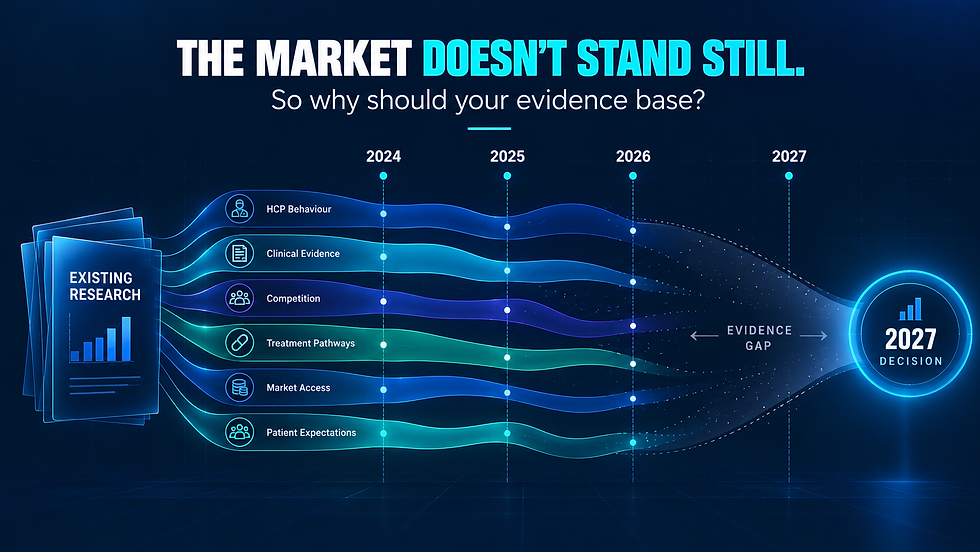
Consider what has typically happened in a healthcare market over 24 months. Treatment guidelines may have been updated. A competitor may have launched or repositioned. New clinical evidence may have altered the prescribing calculus in a particular indication. Digital channels may have changed how physicians engage with clinical content. Patient expectations may have shifted following broader changes in the health system. Market access conditions in key geographies may differ from those at the time of the last substantive research.
None of these changes are hidden. Most can be detected, at least partially, through published sources, field intelligence, and commercial data. But detecting a change is not the same as understanding what it means for your strategy. Understanding what it means requires structured insight. It requires speaking to the right HCPs, in the right way, with the right questions, and a methodology capable of revealing not just what has changed, but why, and what that implies for how the market should be approached in the year ahead.
This is where a healthcare market research partner needs to contribute more than fieldwork capacity. At Insights Alchemy, the research process begins by connecting the business decision to the evidence required to support it. That may mean designing a quantitative HCP study to measure the scale of an issue, using qualitative research to understand the reasoning behind clinical behaviour, or combining approaches when neither method alone can adequately answer the question.
The objective is not simply to generate another dataset. It is to build evidence that can be used while the decision is still being made.
This is what makes research a strategic capability rather than a periodic procurement exercise. The best-placed organisations are not necessarily the ones that commission the most research. They are the ones who commission research against clearly defined decisions and time that research so it can actually inform those decisions rather than confirm them after the fact.
By the time a brand plan is locked and a budget is approved, the research that could have changed those decisions is too late. The research that matters is the research done before the plan is written.
The Q4 Timing Problem
There is a structural tension at the heart of healthcare research calendars. Annual planning tends to peak between September and November. Brand plans, budget allocations, and strategic priorities are being agreed. The commercial organisation is moving into execution mode for the following year. That is also precisely the moment when many organisations realise their evidence base has gaps.
A brief goes out in October. Fieldwork is completed in December if they are fortunate.
Analysis and reporting land in January, by which point the plan for the year is already in motion, budgets have been allocated, and strategic priorities have been set. The research that arrives in Q1 of the following year confirms or challenges decisions that have already been made.
This is not necessarily a fieldwork problem. It is a research planning problem.
For specialist healthcare audiences, the issue can be even more pronounced. Identifying and qualifying the right HCPs takes time. Hard-to-reach specialties may need targeted recruitment and CATI, alongside the panel, to reach the right profile. Multi-market studies require questionnaire adaptation, local clinical calibration, and market-specific recruitment. CATI programmes may require trained interviewers and targeted outreach. Qualitative studies require appropriate specialist recruitment before the first interview can even begin.
The organisations that use research most effectively plan their research calendar as deliberately as they plan their commercial calendar. They identify the decisions that will need to be made in Q4, six months in advance. They identify the evidence gaps that will affect those decisions. They commission the research that can close those gaps in time to actually change the outcome of the planning conversation.
That is a different discipline from commissioning a study once a need has been identified during the planning phase. It requires an honest assessment of where the evidence base is genuinely solid and where it is ageing or incomplete, and the will to invest in evidence before the decision is made, rather than validation after it after.
The research that shapes the best commercial decisions in Q4 was often commissioned in Q2 or Q3 of the same year.
The Question That Determines Everything
The most common source of weak healthcare research is not poor execution in the field. It is that the research question is unclear at the beginning. Not a research topic. A research question. The difference matters enormously.
A research topic is a subject area: HCP perceptions, patient experience, competitive positioning, brand awareness. These are reasonable starting points for a conversation. They are not enough to design a study that produces decision-useful evidence.
A research question is anchored to a decision. It asks what the organisation needs to know in order to decide something, and then takes the next step: what would the answer actually change? That step, defining what would change depending on the finding, is where the research design becomes specific and the evidence becomes useful.
This is an important distinction in the way Insights Alchemy approaches research projects. A client may come with a request for "a study among oncologists" or "200 HCP completes across three markets." Those are useful parameters, but they are not yet the research strategy.
The work lies in understanding what sits beneath them.
Is the organisation trying to understand a treatment decision? Measure unmet needs? Explore perceptions of a therapy? Assess competitive positioning? Identify barriers to adoption? Validate a segmentation? Understand how a particular HCP audience interprets clinical evidence?
The answer determines what needs to be asked, who needs to answer it, and how the research should be conducted.
If the answer to a research question is that the organisation would maintain its current positioning regardless of what the data shows, the study is not really a decision-support exercise. It is a validation exercise. Those are different things, and they produce different kinds of evidence.
Validation research is built to confirm a hypothesis with confidence. Decision-support research is built to reduce uncertainty. Conflating the two produces research designed for validation but interpreted as decision support, where strategic assumptions receive the most uncritical reinforcement.
In healthcare specifically, this is complicated by the nature of the audience. Healthcare professionals are careful communicators. They are trained to qualify their statements, to acknowledge uncertainty, and to express caution where the evidence is incomplete. A well-designed research instrument accounts for this. A poorly designed one records the qualification and misses the clinical opinion beneath it.
That is a questionnaire design problem, not simply a fieldwork problem.
Why HCP Research Has a Different Quality Standard
There is a set of assumptions about respondent quality in general market research that does not transfer safely to HCP research. In consumer research, a large sample with broad demographic targeting is usually a reasonable starting point. Statistical power comes with volume. Panel recruitment is relatively straightforward. And the risk of respondent contamination can be largely managed through standard quality controls.
In healthcare research, the calculus is different.
The relevant population is often small. In rare disease categories, active prescribers may number in the hundreds across a major market. In subspecialties with defined patient populations, the number of physicians with genuine clinical experience in the relevant therapy category may be far fewer than a panel count would suggest.
In that context, respondent qualification is not an administrative step that happens before the research begins. It is part of the evidence itself.
An oncologist who actively manages the relevant patient population and prescribes for the relevant indication has clinical experience directly relevant to the research question. A physician who nominally holds the same specialty but whose practice has moved in a different direction may provide responses that are technically accurate and clinically thin.
The difference between these two respondents does not show up in the final sample report. It will not show up in the data either, unless the research was designed to surface it.
This is where healthcare panel management becomes a genuine methodological question rather than a logistical one. The nominal size of a specialist panel is a starting point. The qualified availability within that panel, for a specific indication, in a specific practice setting, with a specific level of current clinical engagement, is the number that actually determines what the research can deliver.
At Insights Alchemy, this matters most when designing HCP studies for specialist and hard-to-reach audiences. Recruitment is not treated as a simple numbers exercise. The audience definition, qualification criteria, and validation process are built to reflect the actual research problem. This is also why our panel is validated against current professional practice, so the people who qualify into a study are the people the study needs.
Healthcare research conducted through panels that are not regularly validated against current practice carries a structural quality risk that no amount of analytical sophistication can remove. A contaminated sample produces contaminated findings, and the contamination is not visible in the reporting.
Methodology Should Follow the Problem
A persistent challenge in healthcare research procurement is the tendency to select a methodology before the research problem is fully defined.
"We need a 200-complete quantitative study" is a procurement specification. It may be entirely appropriate. It may also be a template applied without examining whether it fits the specific question.
Quantitative research is exceptionally useful for measuring the prevalence of an attitude, the distribution of a behaviour, or the relative priority of a set of attributes across a defined population. It provides statistical confidence and data that are comparable across segments and markets.
Qualitative research can reach the reasoning behind a clinical decision rather than simply recording its outcome. In-depth interviewing with specialist physicians can reveal the frameworks through which they interpret clinical evidence, the shortcuts they apply in practice, and the points of genuine ambiguity where prescribing behaviour is less fixed than a quantitative study might suggest.
Neither method is inherently superior. Each is appropriate or inappropriate depending on what the research needs to deliver.
This is why healthcare research design should begin with the research problem and work outward. If the organisation needs to understand the nature of an issue before measuring its scale, the qualitative phase can come first and shape the quantitative design. If the organisation has a well-defined hypothesis and needs to measure its prevalence, the quantitative study can stand on its own. If both depth and scale are required, a hybrid approach can produce evidence that neither method can generate alone.
CATI is another example of why methodology needs to follow the audience and the problem. For specialist clinical populations that are poorly represented in standard panels, targeted CATI recruitment can reach respondents who meet more specific clinical criteria, and a trained interviewer can verify context and probe responses in ways a purely self-administered approach may not. Used alongside the panel, it widens the reach of a study rather than replacing it.
The important point is that these decisions should be made from the research problem outward, not from a methodological preference or a budget framework inward.
Global healthcare research adds another dimension. Translation makes a questionnaire linguistically accessible across markets. It does not make the underlying clinical assumptions culturally or professionally equivalent.
A question about treatment pathway decision-making in Germany is being asked in a healthcare system with a specific reimbursement structure, a specific primary-to-secondary care relationship, and a specific set of clinical guidelines. The same question asked in Japan, Brazil or Saudi Arabia meets a different version of each of those factors.
The responses can look comparable across markets but mean different things in each.
Reliable multi-market healthcare research therefore requires more than global sample delivery. It requires local clinical understanding at the design stage, appropriate market-level recruitment, and a methodology that preserves comparability without pretending every market operates in exactly the same way.
The Validation Gap

Healthcare organisations that regularly commission research often develop a confidence in their evidence base that is partly justified and partly complacent. The research conducted three years ago was rigorous at the time. The sample was qualified. The questionnaire was well designed. The analysis was thorough. The organisation trusted the findings, and rightly so.
Those findings are now three years old.
The market has moved. Treatment guidelines have been updated. A competitor has repositioned. A new product has entered the category. Patient behaviour has shifted in ways that affect how physicians approach management decisions.
The evidence is still technically accurate as a description of the market at the time. Its relevance to current decisions is a different question, one worth asking explicitly rather than assuming.
This is the validation gap: the gradual accumulation of distance between the evidence base and the current state of the market, which is rarely assessed directly.
Research does not have an automatic expiry date. Its relevance does.
The answer is not necessarily a comprehensive new study every year. In many cases, a more focused review can identify which parts of the existing knowledge base remain reliable and which need updating.
For example, an organisation may have strong existing data on brand awareness but limited current understanding of HCP treatment priorities. A full repeat of the previous study may be unnecessary. A targeted HCP study, qualitative exploration, or focused quantitative module may close the specific gap more efficiently.
That kind of evidence portfolio thinking requires an honest assessment of the currency of existing knowledge. It is also where a research partner can add value beyond executing the next project.
The question is not simply "What research should we commission?" It is "Which evidence do we still trust, and where do we need to know more?"
What Changed This Year
As Q4 approaches, one of the most useful exercises available to a healthcare organisation is to look backwards before looking forwards. Not simply at performance data, but at change.
What changed in the market? What changed among HCPs in the relevant specialty? What changed in treatment behaviour or prescribing patterns? What changed in competitive positioning? What changed in how information is accessed or evaluated? What changed in the questions patients and caregivers are asking?
And, perhaps most tellingly: what did the organisation expect to stay stable that did not?
These questions surface the places where existing knowledge may have become outdated.
A longitudinal tracker may still be running. Brand tracking may be producing wave-on-wave comparisons. Market share data may be coming in regularly. But none of these necessarily explain why the market is moving the way it is, or what that implies for strategy.
That contextual understanding requires asking the people closest to the clinical decisions being made. It may need a targeted HCP study. It may need qualitative conversations with a hard-to-reach specialist audience. It may need CATI outreach where online recruitment cannot deliver the required profile. It may need a multi-market programme that combines a consistent global structure with local market understanding.
The methodology should emerge from the uncertainty. The research design should emerge from the decision. And the evidence should be strong enough to tell the organisation something it did not already know.
That is ultimately more valuable than research that simply confirms what everyone expected to hear.
The Research That Actually Changes Decisions
The final measure of research quality is not methodological rigour, sample size, or the density of the final presentation. It is whether the evidence changed how an organisation thinks about its market.
That sounds self-evident. In practice, it is a high bar. Research that confirms an existing belief is comfortable. It validates a direction already chosen. It makes the planning conversation easier. It typically changes nothing. Research that challenges an assumption is uncomfortable. It complicates a direction already under discussion. It creates questions without obvious answers. It can delay a decision or force a rethink.
The second kind of research is strategically valuable.
The purpose of healthcare market research is not to produce a well-structured presentation. It is to give the organisation a more accurate understanding of the market it operates in, so that the decisions it makes are better than the ones it would have made without that understanding. That means the research has to be designed to produce evidence rather than confirmation. It means the questions have to be capable of producing answers that both challenge and support. It means respondent qualification must be rigorous enough that the findings actually represent the clinical reality under investigation. And it means the organisation commissioning the research must be prepared to take the findings seriously, even when they are inconvenient.
At Insights Alchemy, the research journey can span the full process: defining the research problem, identifying and qualifying the right HCP audience, selecting the appropriate methodology, conducting CATI or online fieldwork, managing qualitative or quantitative research, supporting multi-market recruitment, and interpreting the evidence in the context of the decision it was designed to inform.
The organisations that do this consistently tend to bring a different level of clarity to their planning cycles. Not because they have more data than their competitors, but because they have a clearer sense of what they know, what they are assuming, and where the genuine uncertainty lies. That clarity is the output that matters. The report is just how it gets communicated.
Before You Plan 2027, Ask What You Still Do Not Know
The final quarter is when most healthcare organisations consolidate what they learned this year and set the direction for the next. It is also when the quality of the evidence base becomes apparent.
Organisations that invest in structured insight during Q2 and Q3 enter the planning season with evidence. Organisations that wait until planning surfaces the gaps enter it with the intention to learn something that may already be too late to act on.
The most valuable question to ask before any planning cycle begins is not what the data shows. It is what the data does not yet tell you, and whether the decisions you are about to make are ones you can afford to make without that information.
From there, the design follows naturally: from the decision to be made, to the evidence required, to the audience and methodology capable of producing it, to the timeline that lets it inform rather than confirm. That sequence, decision first, evidence second, methodology third, is what turns research from a periodic information exercise into a genuine strategic capability.
And when the decisions made today are the ones that will shape markets, brands, and patient outcomes for the year ahead, that distinction matters more than almost any other investment healthcare organisations make in understanding their world.
Frequently Asked Questions
What makes healthcare research strategically valuable?
Healthcare research becomes strategically valuable when it is designed around specific decisions rather than general topics. Research that can challenge an assumption or reduce a genuine uncertainty has more strategic value than research that confirms a direction already chosen. The measure is not the volume of evidence but whether it altered the thinking of those who commissioned it.
How should healthcare organisations time their research calendar?
Research that informs annual planning is typically commissioned six to twelve months before the decisions are made. Research commissioned once the planning gap has already been identified often lands too late to change the decision it was meant to support. Building a research calendar alongside the commercial calendar is the structural change that makes a consistent difference.
Why does respondent qualification matter so much in HCP research?
In healthcare research, a respondent's clinical relevance is part of the evidence. A physician with active, current experience in the relevant indication produces insight that is substantively different from that of one who nominally matches the specialty but whose practice has moved elsewhere. That difference does not show up in a sample report, and will not show up in the data unless the study was designed to surface it, which is why qualification is a research design decision, not a logistics one.
When is CATI the right methodology for healthcare research?
CATI is particularly useful when the target audience is a specialist clinical population that is not well represented in standard panels, when the research needs to probe beneath professional caution to reach genuine clinical opinion, or when qualification needs to be verified through live conversation rather than a screener alone. For hard-to-reach specialists, CATI with targeted outreach can reach profiles that are thin in any online panel, so the two work best together rather than one replacing the other.
How should multi-market healthcare research be designed?
Multi-market healthcare research needs local clinical expertise at the questionnaire design stage, not only at the translation stage. Prescribing environments, treatment pathways, and clinical decision-making differ enough across markets that a questionnaire designed for one context can produce distorted results in another. Translation ensures linguistic accessibility. Clinical calibration ensures the findings are professionally and contextually meaningful.
What is the validation gap in a healthcare evidence base?
The validation gap is the accumulated distance between an organisation's existing evidence and the market's current state. Research that was rigorous when conducted may no longer describe a market that has since evolved. Regular evidence reviews that check whether existing studies still reflect current clinical and market realities are as strategically important as commissioning new research.
How do you know when research is actually changing decisions?
Research that challenges an assumption, complicates a direction, or surfaces an unexpected finding is more likely to change decisions than research that confirms an existing belief. The strongest indicator is not comfort with the findings but clarity about what the organisation will do differently as a result.
Insights Alchemy works with healthcare, pharmaceutical and life sciences organisations across HCP research, healthcare market research, CATI, qualitative and quantitative research, and multi-market recruitment, drawing on a healthcare panel of 1.8M+ professionals. ISO 20252 and 27001 certified.
We work direct or white label behind agencies and consultancies, designing evidence that informs decisions rather than simply confirming them.
Learn more at insights-alchemy.com


Comments